Armor Helmets: Selection, Uses and Display Guide
Compare helmet forms, finishes, supports and display scale while keeping historical replicas distinct from fantasy designs.
Use observable features and careful wording to distinguish historically inspired helmet forms from fantasy styling.
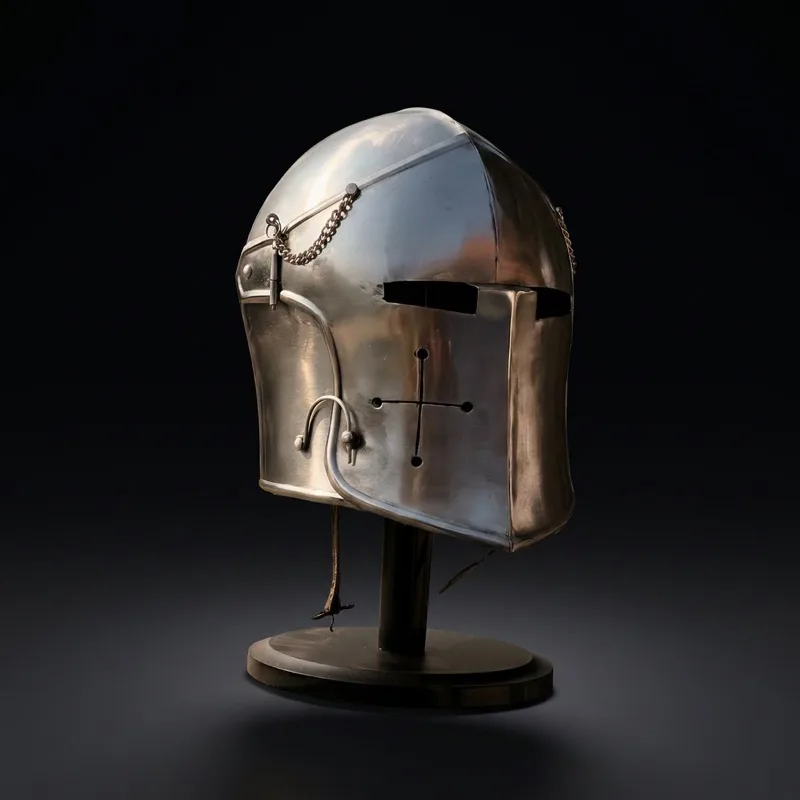
A helmet can look medieval without being a historical artifact or a faithful copy of one specific surviving helmet. Product titles often combine a type name with terms such as Crusader, Gothic, Renaissance or fantasy. Those words can help shoppers understand the intended aesthetic, but they do not independently verify date, region, original function or maker.
The clearest description separates three things: what the object visibly is, what the seller says inspired it, and what can be established from a historical source. This makes product captions useful while avoiding accidental claims of provenance.
Start with observable features: open face or visor, a bevor, plume, chain detail, crest, surface finish, material as specified and whether a stand is included. A label such as “steel sallet-style helmet with visor and bevor” communicates more than “authentic medieval knight helmet” when no provenance is supplied.
The word replica means a contemporary reproduction. “Antique finish” describes a surface treatment; it does not mean antique age. Similarly, a decorative helmet made from steel is not automatically protective equipment. If it is sold for costume use, state that context and avoid claims about safety unless supported by applicable product documentation.
Museum records show why precision matters. The Metropolitan Museum catalogues one sallet as Italian, Milan, about 1470–80, and describes a range of sallets as open-faced or visored forms. Another Met record describes a Venetian-style sallet and discusses blue or black coloration and later mounts. These are documented histories of specific objects, not a shortcut for dating every similarly shaped helmet.
A product may share a broad silhouette with a historic type while differing in proportions, construction or decoration. Write “inspired by,” “sallet-style” or “barbuta-inspired” when that is the level of evidence. Reserve claims such as “a replica of the 1470 Milan helmet” for a model whose maker has documented that exact relationship.
| Safer wording | What it communicates |
|---|---|
| “Barbuta-inspired steel display helmet” | A visual reference and stated material |
| “Sallet-style form with visor and bevor” | Visible type cues and components |
| “Fantasy design with plume and contrasting finish” | A deliberate imaginative treatment |
| “Replica of a specific museum helmet” | Use only when the exact source is documented |
CrestX 11.2 (crestx-11-2) is titled as an Italian barbuta and its catalogue description says Italian barbuta form; its specification lists steel and an 11-inch height. This supports a cautious “Italian barbuta-style” description of the product’s stated design language. It does not prove manufacture in Italy or an exact Renaissance date.
CrestX 12.0 (crestx-12-0) is described as a Gothic sallet with bevor and visor. CrestX 12.2 (crestx-12-2) is listed with an open visor and horsehair plume and a steel/brass material description. Those added elements can be described as design details. Do not turn them into a claim that a particular historical army, rank or tournament used this exact object.
Fantasy styling often combines recognizable historic components with exaggerated proportions, unusual colours, dramatic crests or cross-period decoration. That is a legitimate design category, not a defect that needs to be disguised. A clear caption can say “fantasy-inspired steel helmet with plume” and explain the visible finish. Avoid attaching an exact century merely because the design contains a visor or pointed profile.
When historical and imaginative elements coexist, use a two-part description: “A contemporary costume replica combining a sallet-style visor with an ornamental plume.” This is both more precise and more interesting than calling every such helmet authentic medieval armor.
A historical label answers what the design references. A product specification answers what materials and parts are listed. A safety statement answers whether the object is appropriate for a particular use and needs separate documentation. Do not infer protective capacity, impact resistance, visibility or reenactment suitability from appearance or metal thickness unless the seller provides explicit evidence.
For shop displays, include a short caption and, where useful, a note that the item is a contemporary reproduction. For costumes, make intended use and any limitations visible to the wearer. For educational displays, cite a museum object directly when making a comparison and be specific about what is shared and what differs.
Accurate wording lets the object’s shape remain compelling. Describe the visible form, attribute inspiration carefully, and leave provenance claims to evidence that actually documents them.
Catalogue reference: CrestX 003. Listed material: Steel.
Check the current product page and ask for model-specific dimensions, packaging and suitability before ordering.
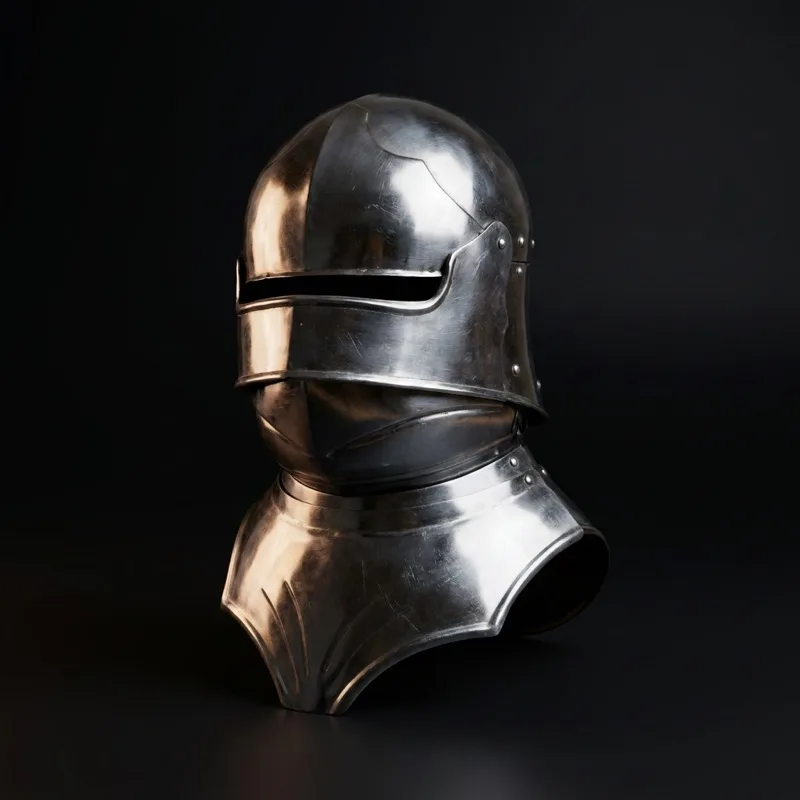
Catalogue reference: CrestX 012. Listed material: Steel.
Check the current product page and ask for model-specific dimensions, packaging and suitability before ordering.
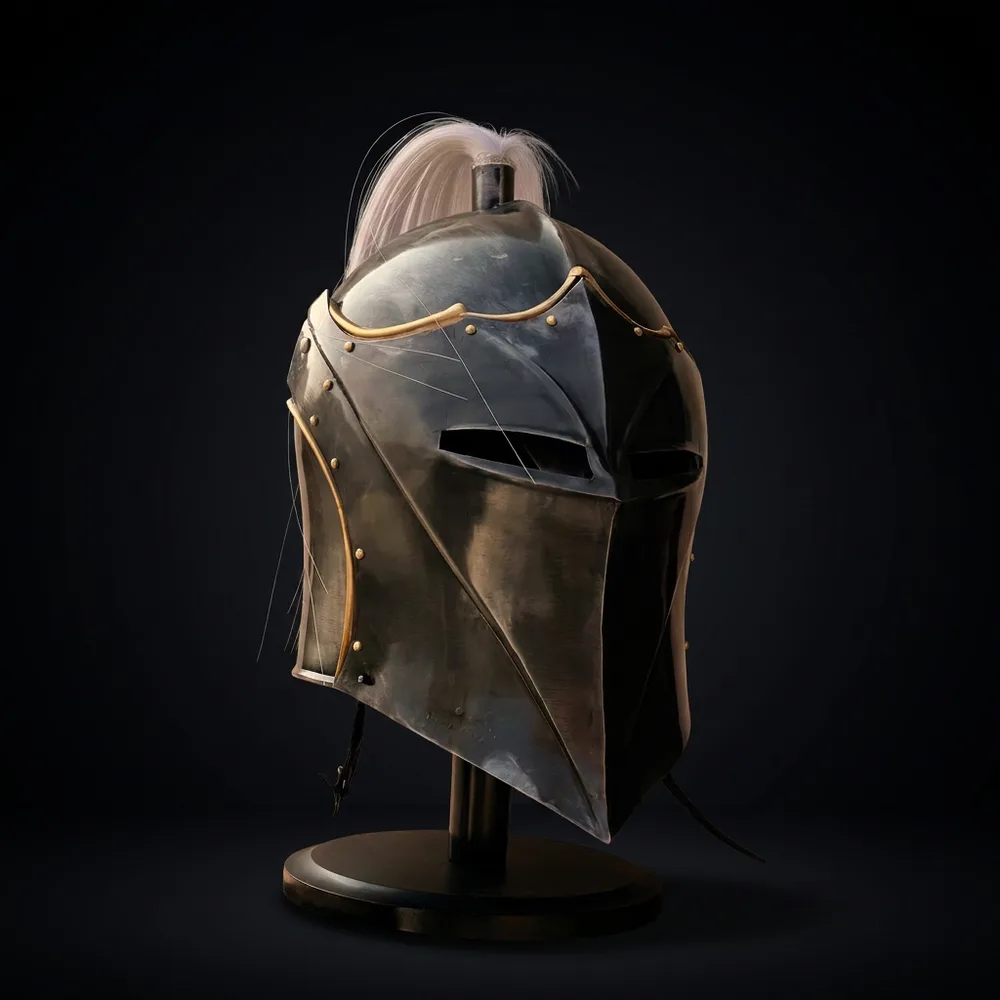
Catalogue reference: CrestX 014. Listed material: Steel/Brass.
Check the current product page and ask for model-specific dimensions, packaging and suitability before ordering.
Explore Antiqula’s armor helmets catalogue
Catalogue examples were checked against Antiqula’s product records on 2026-10-02. Research sources provide context; they do not certify the performance of individual catalogue products.