Choosing a Diving Helmet Replica for a Maritime Display
Plan scale, support and interpretation when selecting miniature or larger diving helmet reproductions for an interior or retail display.
Use viewing distance, furniture dimensions and handling needs to choose the right scale for a decorative diving helmet.
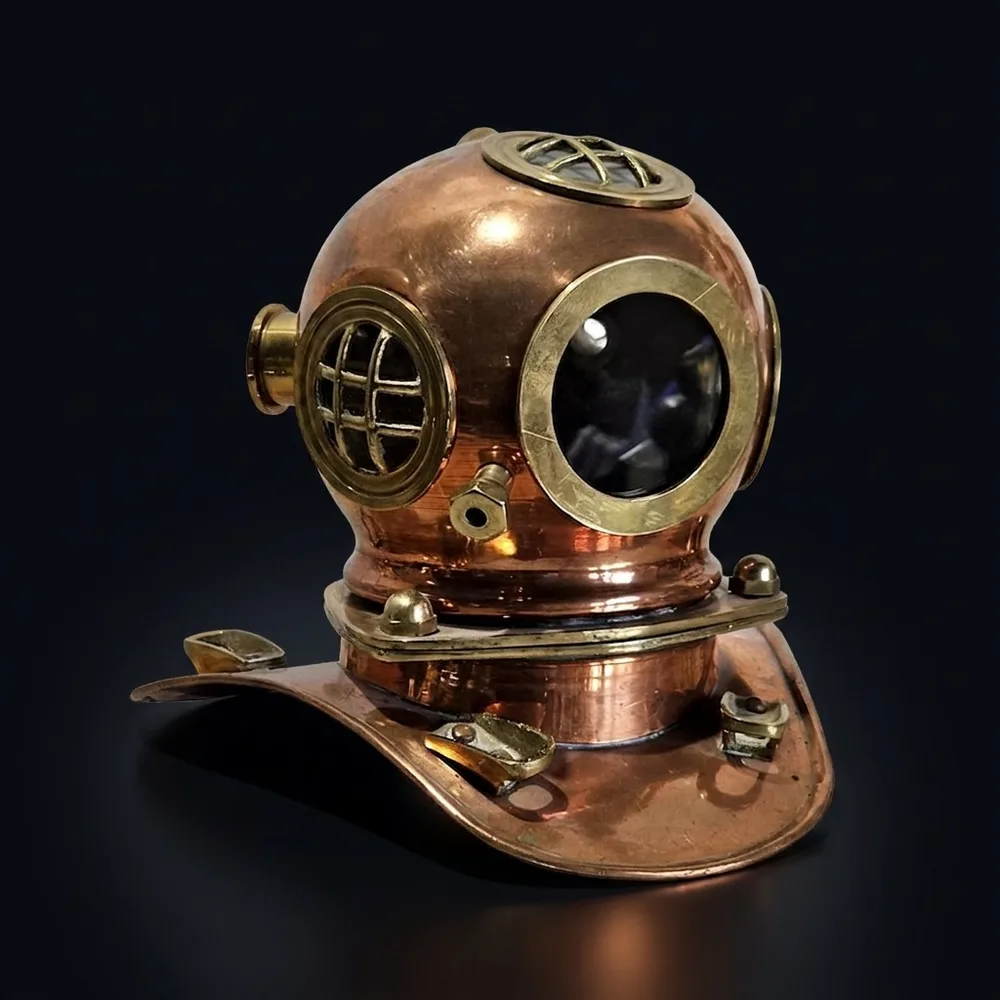
A miniature diving helmet and a larger replica can tell the same maritime story at very different distances. The miniature invites a close look at details. The larger form establishes a silhouette across a room. Choosing between them is a spatial decision before it is a question of finish.
Both should be described as decorative reproductions. Neither scale makes a replica suitable for diving, breathing or protective use. Larger dimensions can make an object look operational, so the display caption should be especially clear about its intended role.
Imagine where a person will first notice the object. On a desk, the viewer may be close enough to inspect the windows, fittings and surface. A small piece can be legible there without overwhelming the workspace. In a lobby or large shop window, that same piece may be visually lost.
A larger helmet can be effective at a distance, but it needs room around it. Treat the empty space as part of the display. If every side is pressed against another object, the helmet’s distinctive outline becomes harder to understand. Size alone cannot compensate for a crowded arrangement.
Request height, width, depth and weight for the exact reference. Include protruding fittings and any base. Do not rely on the diameter of the rounded upper section. Also request packed dimensions, because the route into the building may be more restrictive than the final display space.
For a shelf, measure usable depth and clearance above the object. For a console, consider the edge distance and whether the display sits in a path where people carry bags. For a public plinth, ask a competent installer to assess support and stability. A photographed arrangement is not an installation specification.
| Consideration | Miniature form | Larger display form |
|---|---|---|
| Viewing | Detail at close range | Silhouette from farther away |
| Placement | Shelf or desk possibilities | Dedicated furniture or plinth |
| Movement | Still requires confirmed handling points | Weight and delivery route become central |
| Interpretation | Small caption beside the object | Clear identification visible to approaching visitors |
| Packaging | Protect small projecting details | Confirm base, fittings and unloading arrangement |
This comparison describes common display considerations rather than a guarantee about every product. Confirm the selected model’s construction and support. Some miniature catalogue references include a wooden base; another is described without a stand. Those differences can change the final height and presentation even within one scale.
A helmet has enough visual detail to carry a simple display. Begin with a plain background and one supporting element, such as a clearly identified map reproduction or a short interpretive card. Add objects only when they help explain the subject or establish scale.
For a polished finish, check reflections from windows and lighting. For a darker finish, make sure the window outlines remain visible. View the arrangement from the room entrance as well as from directly in front. The best close-up arrangement may not be the clearest one from a distance.
A small replica may tempt a visitor to pick it up. A larger one may tempt someone to touch a fitting or try to wear it. Establish whether handling is intended, request guidance and arrange the display accordingly. Do not invite interaction with parts whose attachment or function has not been verified.
If staff move the object for demonstrations or cleaning, record the approved handling method. Never assume a projecting connector is a handle. Keep care instructions with the display record so the chosen finish is not later altered by enthusiastic polishing.
Select a miniature when the display is personal, close and supported by modest furniture. Consider a larger form when it needs to be read across a room and the support, access and delivery arrangements can be established. In both cases, confirm actual dimensions rather than trusting the scale label.
The right replica is the one that has enough space to be understood. A clear caption, appropriate support and deliberate placement will usually contribute more than adding extra maritime props around it.
Catalogue reference: ShoreX 8.0. Listed material: Brass & Copper.
Check the current product page and ask for model-specific dimensions, packaging and suitability before ordering.
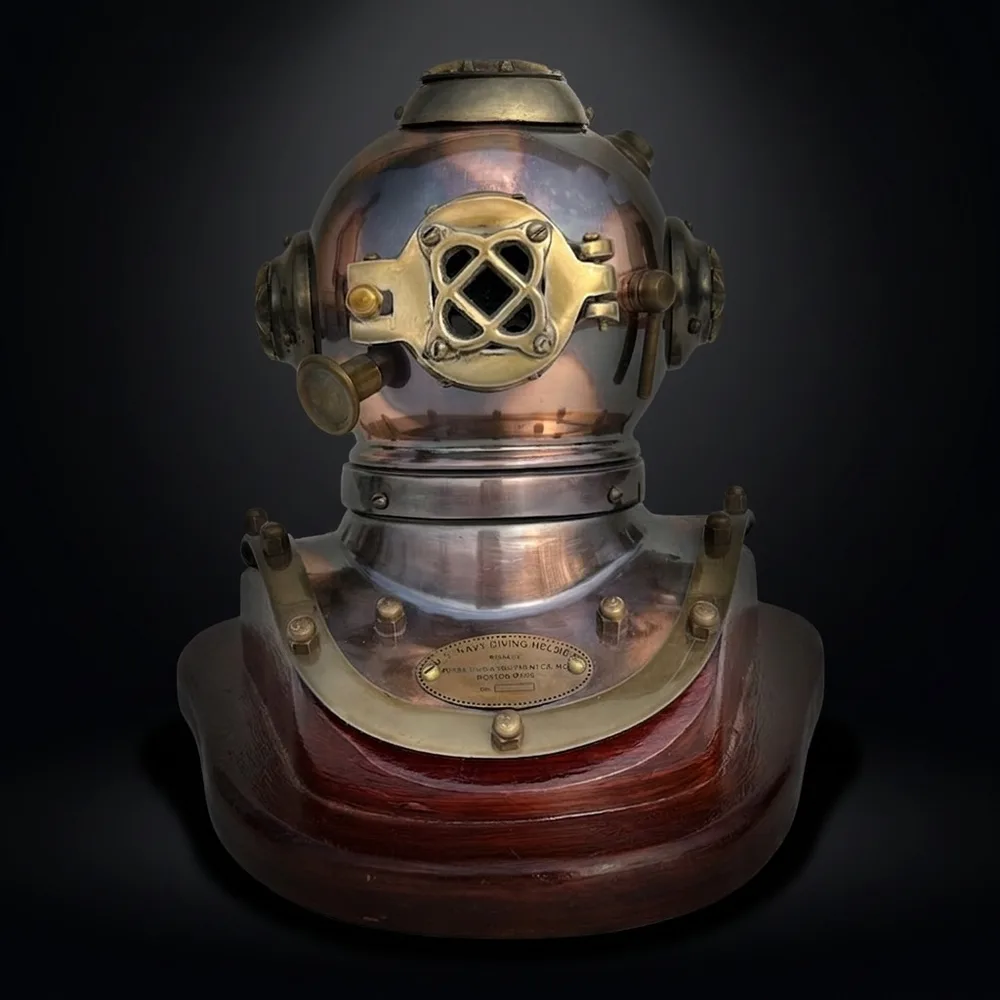
Catalogue reference: ShoreX 8.1. Listed material: Steel & Aluminum.
Check the current product page and ask for model-specific dimensions, packaging and suitability before ordering.
Explore Antiqula’s diving helmets catalogue
Catalogue examples were checked against Antiqula’s product records on 2026-10-02. Research sources provide context; they do not certify the performance of individual catalogue products.